

Tuber borchii Vittadini
Monographia Tuberacearum 44, Tab. I fig. III (1831)
(Click on the picture to see more images)
Synonyms:
Tuber albidum Pico (1788), Melethemata Inauguralia. De fungorum generatione et propagatione 79
Tuber album Bulliard (1788), Herbier de la France tab. 404
Macroscopic characters:
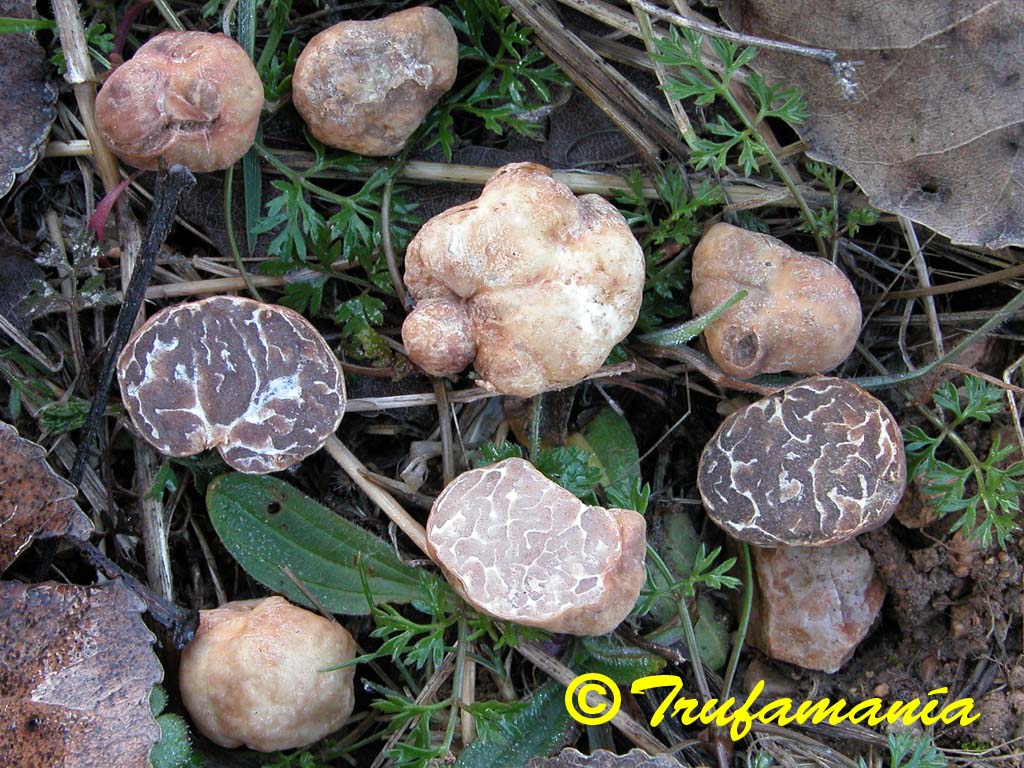
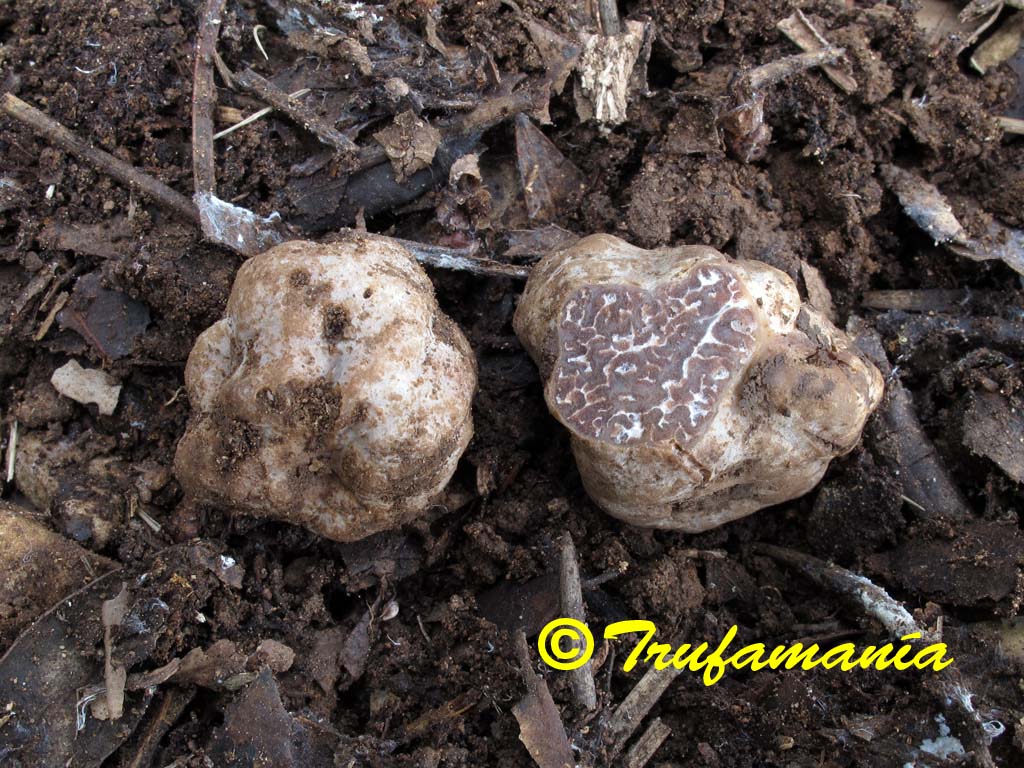
Ascomata: hypogeous, subglobose or irregular in form and gibbous, 2–3 (7) cm in size, smooth, pubescent at first, glabrous at maturity, initially whitish, becoming brownish ochre, often with reddish spots.
Gleba: firm, solid, whitish at first, then beige, reddish brown at maturity, marbled with white, wide, anastomosing veins which arise from various points on the periphery.
Odour: tuber-like, garlicky, pleasant at first, strong and unpleasant with age.
Taste: strong, pleasant at first, garlicky.
Habitat
Tuber borchii is tolerant of a wide variety of soils, but prefers well-drained, sandy calcareous soils. It can be found in clay and sandy soils, in association with conifers or broad-leaved trees, in both calcareous and acid soils. Truffles ripen from January to late April.
Notes:
Tuber borchii, Tuber dryophilum, Tuber maculatum and Tuber puberulum form a group of white truffles with reticulate-alveolate spores that are difficult to tell apart. They share similar macroscopic and microscopic characteristics and sometimes show a range of intermediate forms between species, making it not always possible to differentiate one from another.
Tuber borchii is an edible truffle, gastronomically appreciated when young. It was first cultivated in Italy in 1990.
(Click on the picture to see more images)
Microscopic characters:
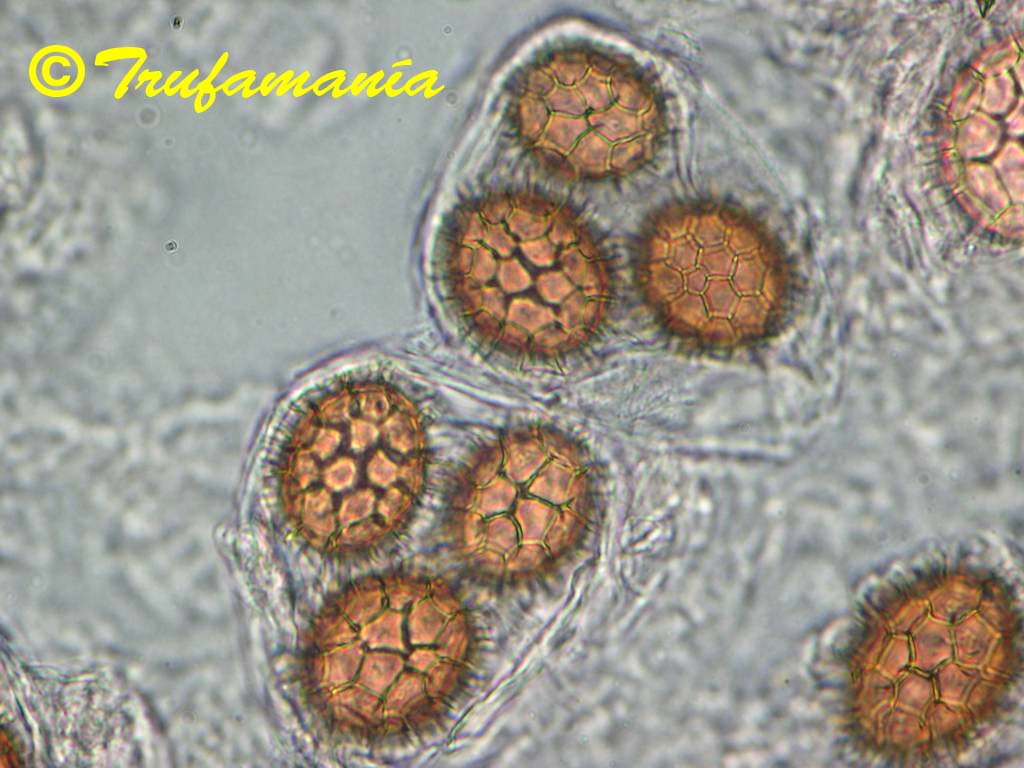
Asci: subglobose to ovate or ellipsoid, sessile or short-stalked, 70-100 x 50-80 µm, 1-3 (-4)-spored (usually 3-spored)
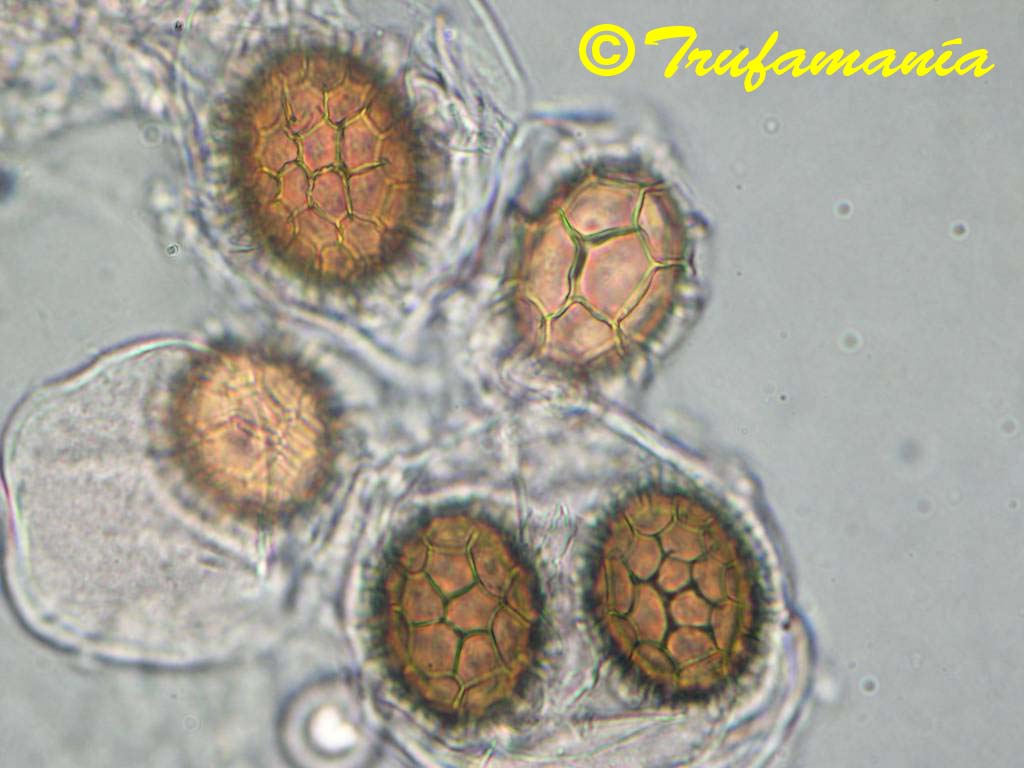
Ascospores: 32-47 (-55) x 23-39 (-42) µm excluding ornament, size variable depending on number of spores in the ascus, Q range = 1,06-1,46, ellipsoid to broadly ellipsoid, light yellow, brown at maturity, translucent, ornamented with a regular reticulum with meshes 4-7 (-10) µm high, 4-10 µm long, 4-8 across width of spore.
Peridium: 150-200 µm thick, whitish, pseudoparenchymatous, composed of subglobose to polygonal cells, 10-30 µm diam, densely covered with hairs in young specimens. Hairs 40-70 µm long, 4-5 µm across at the base, tapered, hyaline, septate.
 |
Antonio Rodríguez trufamania@gmail.com antonio@trufamania.com |